
Assalamualaikum and welcome to my blog!
Hi! My name is NURFARRAHIN BINTI ROMZI. I am currently studying at UiTM Dungun, Terengganu. I am also an undergraduate of HM110 (Hotel Management). Being alone in Terengganu without my family is actually a big challenge for me because I’m actually from Selangor and it’s my first time being away from my family. But, I believe this will be the moment where I’ll get to grow up.
So in this blog, I will share what I’ve learned from the lectures every week.
Contents of UED102:
- Learning Style Inventory.
- Goal Statements – The Five Step Approach
- Fixed-Commitment Calendar
- Job Task Analysis
- Prioritized To-Do List
- Memory Strategies
- Organizational Strategies
- Concentration Strategies
- Concentration Chart
- Reading Text
- Note-Taking Strategies
- Note-Taking Exercise using the Cornell Method
- GPA Worksheet
MODULE 1: LEARNING STYLE INVENTORY

First of all, it is significant to know your own learning style to achieve or be a good student.

Visual
The information should be seen first by visual learners to be fully remember.If you great in visual style learning, you will have strong visualization skills and eventually remember objects, shapes, and pictures. You learn by reading, and by watching films, videos, and demonstrations. You can see pictures in your mind.
Auditory
Auditory learners need to hear information. If your preferred style is auditory, you have a “good ear” and can hear differences in tones and rhythm. Reading out loud will be beneficial. You can remember what you hear in a lecture.
Kinesthetic
Kinesthetic learners need to be physically active and doing things. If your preferred style is kinesthetic, you are a hands-on learner. You have good coordination and learn by doing. You generally have an active approach to learning.
What is your type of learning?
This is how I found out my learning skill.


Based on the result, I am a mixed of Visual and Auditory learner!
By knowing your learning style(s), you will have an idea of the important role your senses play in the learning process. The best strategy is to combine modalities whenever possible. Incorporate visual, kinesthetic, and auditory learning into your study plan. Using combinations will strengthen your ability to retain information. Be creative. Add your own ideas.
Here are some strategies:
Visual learners:
- Create mind maps, flow charts, and diagrams using bright colors. Put them where you can view them frequently.
- Practice building your visual memory.
- Rewrite your notes using different colors.
Auditory learners:
- After you read a page in your textbook, summarize the information out loud in your own words.
- Tape your instructor’s lecture, and if you are a commuter, listen to the tape on the way home, either in your car, or on the bus or subway.
- Discuss the material that you have been learning with a friend or study group.
Kinesthetic learners:
- Use your hands. Cut up charts and diagrams. Create flash cards and move them around with large, sweeping movements.
- Walk and talk the information. Recite as you move.
- Type on a computer keyboard. You are using your muscle memory.
Additional ways you can use multi-sensory learning:
- Use background music (no lyrics to distract you) when you study. Choose a piece of music for a particular subject. Every time you study that subject, play the music. You are creating an association for your subconscious mind. You may be surprised to discover how much of the information you remember when you play the music by itself. You are combining Visual and Auditory modes.
- Use rap or rhyme to memorize information. To add Kinesthetic to this Auditory mode, walk, dance, or clap when you sing.
8 steps to college success
Set Goals.
Goals help to keep you going by:
- Providing direction
- Increasing your attention and focus
- Increasing your motivation and effort
- Reducing your anxiety and increasing your confidence
Develop SMART goals that are: Specific, Measureable, Achievable, Realistic, and Timely
Step 2: Have a Positive Attitude
- Be positive about your ability to succeed
- Look forward to what your will learn
- Have an inquiring mind: get curious about your subjects!
Step 3: Manage Your Time
- Set a realistic schedule for yourself
- Know where your time goes (awareness is key)
- Study for 2-3 hours for every hour of class time (eg. if you have 6 hours of class per week, aim to study at least 12-18 hours per week).
Step 4: Read Textbooks & Course Readings
- Survey chapters before reading; read the chapter summary, look for bold and italicized words to indicate important concepts
- Review chapters and readings before class
- Re-read chapter and readings after class
- Make study notes
Step 5: Attend your Lectures
- Intend to learn something each class you attend
- Do assigned readings before class- you’ll take better notes
- Ask questions: this will enhance your learning process
- Sit in the first few rows – you’ll pay closer attention
Step 6: Record your Lecture Notes
- Take notes in class
- Review and edit notes after class (within 24 hours)
- Aim for 3-4 major reviews of your notes before exams
- Highlight import points, draw diagrams, make definitions
Step 7: Prepare for Exams
- Review past exams
- Make practice study questions
- Memorize definitions and formulae – try cue cards
- Know the type of exam to expect
- Eat balanced meals and sleep 8 hours per night
Step 8: Write Your Exams
- Have a positive attitude; do your best
- Arrive early with an extra pen and any necessary supplies (e.g., calculator if permitted – with fresh batteries)
- Read test questions and instructions very clearly
- Budget your time; leave time for review
- Relax and don’t forget to breathe
MODULE 2: GOAL STATEMENTS – THE FIVE STEP APPROACH
What are goals?

Importance of goals:
- Goals give you focus.
- Goals allow you to measure progress.
- Goals keep you locked in and undistracted.
- Goals help you overcome procrastination.
- Goals give you motivation.
Characteristics of goals:
- Goals should be self-chosen.
- Goals should be moderately challenging.
- Goals should be realistic.
- Goals should be reasonable.
- Goals should be specific.
- Goals should be finite.
- Goals should be positive.
Academic and Personal Goals:
- Academic goals pertain your studies and your educational pursuits.
- Personal goals are the ones that involve you improving yourself, becoming more balanced in your reactions, dieting and fostering discipline so that all other goals are much more easily attained.

Benefits of goal setting for students:
- Giving a centering.
- Goals help you save priorities.
- Giving a feeling of reason.
- Compelling inspiration.
- Create obligation and sufficiency towards oneself.
- Giving guidance.
- Encourage arranging.
- Persuading representative.
- Constraining anxiety.
- Snappier results.
MODULE 3: FIXED-COMMITMENT CALENDAR
TIME MANAGEMENT & ORGANIZATIONAL SKILLS
TIME IS THE INDEFINITE CONTINUED PROGRESS OF EXISTENCE AND EVENTS IN THE PAST , PRESENCE AND FUTURE .
TIME MANAGEMENT IS THE ABILITY TO WE ONCE TIME EFFECTIVELY OF PRODUCTIVITY ESPECIALLY WORK .
Why students fail or drop out of college?
- Not ready for college, unable to assume responsibility.
- Wrong speciality area.
- Skills aptitude.
- Lack of motivation.
- Wrong priorities.
- Procrastination.
Organizing your study times:
- Time Management Strategies
- Reduce Procrastination

Time management in Islamic perspective.
Plan ahead and divide up your day.
1) Rasulullah SAW stated “I have divided my time into three equal parts – on part for worship, one for my family affairs and the last part I have further divided into two, one for social engagements and on for rest.”
2) Use a daily/weekly planner to plan your activities.
Plan your day around Salah.
Fitting Salah into your schedule, instead of planning your schedule around salah.
Prioritize and be consistent.
Eliminate time wasters! Focus!
Discipline.
Personal Schedule

- Time management tips:
- Eliminate distractions
- Be focused at the task at hand
- Use a calendar
- Use a checklist
- Get organised
- Schedule rewards
- Get a good night’s sleep.
Procrastination
REDUCING PROCRASTINATION
PROCRASTINATION IS THE ACT OF PUTTING OFF INTENTIONALLY THE DOING THAT SHOULD BE DONE .
- Common reasons why people procrastinate:
- Being a perfectionist
- Avoiding failure
- Avoiding success
- Being rebellious
- Being lazy
- Feeling overwhelmed
- Strategies to overcome procrastination:
- Know what you should accomplish
- Determine deadlines
- prioritize
- Break a task into a series of steps
- Do an unpleasant task first
- Change how you think about the task
- Have fun with the activity
- Advantages of being organised:
- Keep on schedule and meet deadline
- Reduce stress with something that you like
- Complete with less pressure and fulfill your potential
- Build your confident
- Avoid overlapping an assignment and having a juggle more than one piece of work at the same time.
Designating Priorities

MODULE 4: JOB TASK ANALYSIS
Job task analysis also is a way that you can manage your time effectively. It can help us to keep up the thing and meet deadline, reduce stress and complete work without any pressure. As a student, it is important to do a job task analysis. Analysing task have two things which is the importance scale and frequency scale.

MODULE 5: PRIORITIZE TO-DO LIST

Studies have shown that people perform better when they have written down what they need to do everyday. Almost everyone struggles with getting stuff done especially as a student. As a student, it is important to do their to do list everyday. It can help you manage your time and prevent yourself from wasting time. We all have those days when there are a million things to do, and we don’t know how we’re going to get it all done.
One of the important reason is for the organization. As a student we usually have many assignment to do. So, when you list your assignment in to do list, it will make your feel organized and finish it before the dateline. Organizing your tasks with a list can make everything much more manageable and make you feel grounded.
Secondly, to do list also can make you easily to review which one is the most important task. Student must know how to differentiate task. Example from the most important task and the task that we can do it later. Your to-do list will help you focus your attention on the most important task of the moment.

MODULE 6: MEMORY STRATEGIES

Memory and Learning

Memory Process
What is memory?
Memory is the faculty of the brain by which data or information is encoded, stored, and retrieved when needed. It is the retention of information over time for the purpose of influencing future action.[1] If past events could not be remembered, it would be impossible for language, relationships, or personal identity to develop.[2] Memory loss is usually described as forgetfulness or amnesia.
What is brain?

The Storage (Retain Information)

- Sensory memory

- Short-term memory

- Long-term memory

Memory Strategies

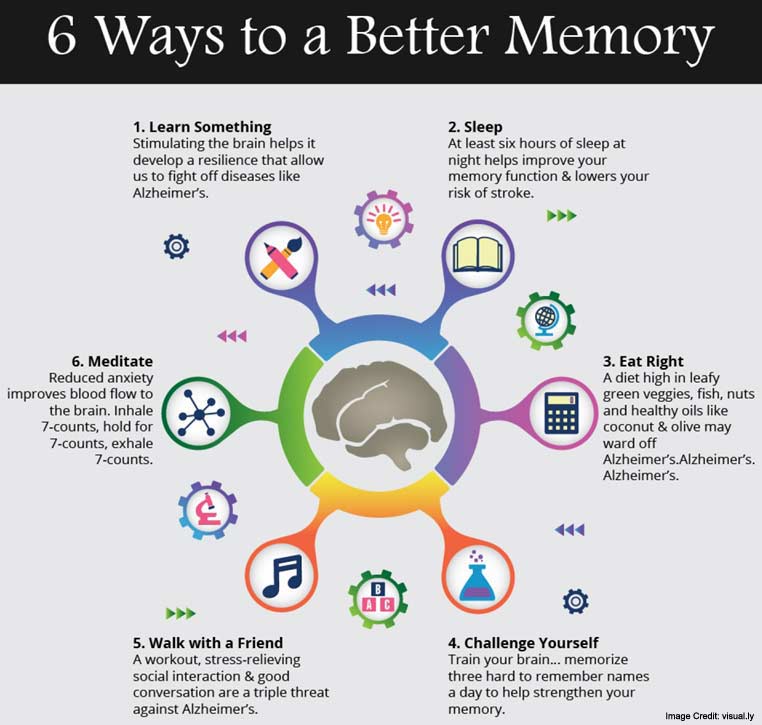
How to improve your memory?
MODULE 7: ORGANIZATIONAL STRATEGIES
Organizing study times.
- DOs:
♠ Use the time management in your phone
♠ Calendar/Reminder/keep
♠ Plan your your time daily including the free time what are you going to do.
♠ Work out how much time you available,and when
♠ List out the task
♠ Work out priorities between these task . Which is more important.
♠ Make decisions about how long to spend on each task
♠ Set target for each work
♠ Less daunting task
- DON’Ts:
♠ Do not try to do it all at once
♠ Neglect of any your courses
♠ Allow yourself to be distracted
- Optimising study times
🎧 Prioritize to-do list . Label it with high priority, medium priority, low priority and additional tasks including the date.
🎧 Put a number , starting with one , next to all of your subjects or exams.
🎧 Take into account difficulty of the subject or exams.
🎧 Take into account the amount of reading you will do.
🎧 Take into account the amount of reviewing what you need to do.
🎧 Often meet the lecturer after the class for more understanding process instead study it alone.
MODULE 8: CONCENTRATION STRATEGIES

How to improve concentration?

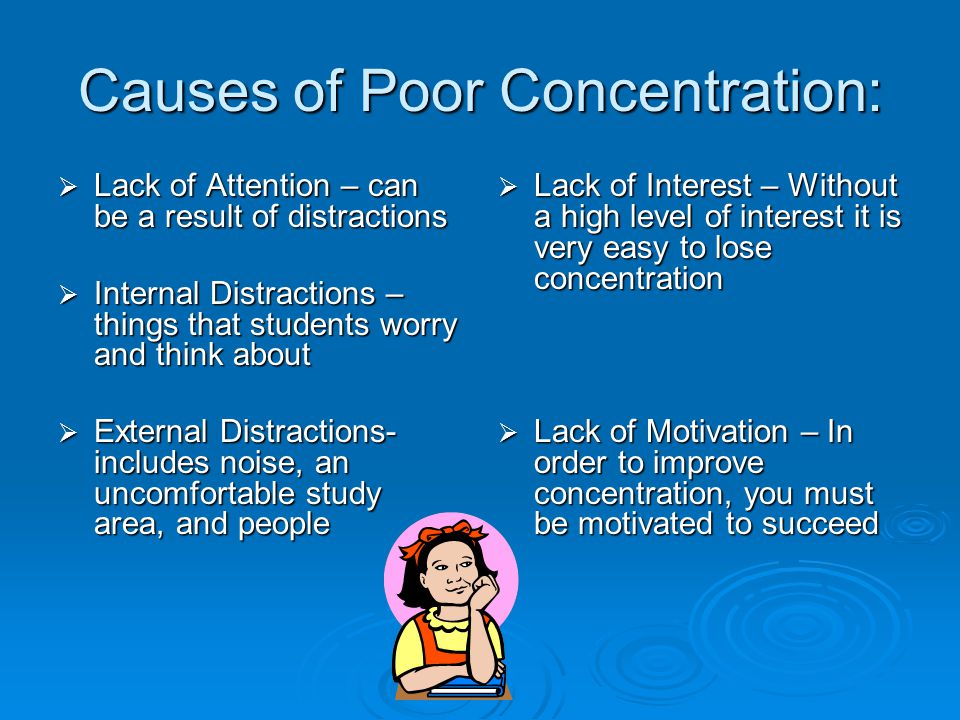
What causes poor concentration?
Strategies to improve concentration.
1. Pay attention.
You cannot take in information unless you are paying attention, and you cannot memorize information unless you are taking it in. Get enough food and sleep, and avoid distractions such as a background radio or television.
2. Involve as many senses as possible.
For example, if you are sitting in a lecture, you will remember more of what is being said if you listen and scribble down a few notes. Or if you are reading a letter or an article, you will remember more of what is written if you read it aloud to yourself.
3. Relate new information to what you already know.
New information is much easier to remember if it can be contextualised. For example, if you are prescribed a new antidepressant drug, you can relate its side-effects to the side-effects of your old antidepressant drug. Or you might notice that both antidepressant drugs are from the same class of drugs, and thus that they have similar side-effects.
4. Structure information.
For example, if you need to remember what ingredients you need to cook a meal, think of them under the subheadings of starter, main course, and desert, and visualize how many ingredients there are under each sub-heading. Or if you need to remember a telephone number, think of it in terms of the five first digits, the middle three digits, and the last three digits.
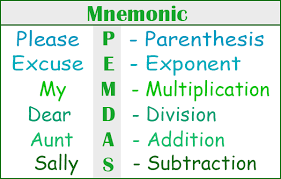
5. Use mnemonics.
That is, tie information to visual images, sentences, acronyms, or rhymes. For example, you might remember that your hairdresser is called Sharon by picturing a Rose of Sharon or a sharon fruit. You might remember the order of the colours of the rainbow with the sentence, ‘Richard of York got beaten in Versailles’. Or you might remember, as medical students do, the symptoms of varicose veins with the acronym ‘AEIOU’: aching, eczema, itching, oedema, and ulceration.
6. Understand information.
Try to understand more complex material before you try to remember it. If possible, summarize the material in your own words and write or type out your summary. Reorganize the material or your summary of the material so that it is easier to remember. By manipulating the information in this way, you are forcing yourself to think about it actively.article continues after advertisement
7. Rehearse information.
Review the information later on the same day or sleep over it and review it the following day. Thereafter, review it at regular, spaced intervals until you feel comfortable that you know it well enough.
8. Exercise your mind.
Mental challenge can help to create new wire connections in the brain, which makes it more effective and more resistant to memory disorders such as Alzheimer’s disease. So develop a new hobby, read a novel, learn a foreign language, or practice yourself at crosswords or sudoku.
9. Develop a healthy lifestyle.
Eat a healthy, balanced diet, take regular exercise, and avoid smoking. A healthy lifestyle increases the amount of blood and oxygen that is delivered to the brain, and reduces the risk of medical conditions that can lead to memory loss such as Alzheimer’s disease, stroke, and diabetes. Exercise also increases your ‘feel-good’ endorphins, which improves your mood and prevents depression. Depression results in impaired attention and concentration, and is also a risk factor for Alzheimer’s disease.
10. Get sufficient sleep.
Sleep is necessary for memory consolidation, and feeling alert and refreshed improves your attention and concentration.
11. See a doctor.
Certain prescribed and over-the-counter drugs can impair your attention and concentration, and hence your memory. If you suspect that this is the case for you, see your family doctor. You should also see your family doctor if you begin having memory problems that affect your ability to get by on a day-to-day basis.
MODULE 9: CONCENTRATION CHART

MODULE 10: READING TEXT

MODULE 11: NOTE-TAKING STRATEGIES
You need to understand what you write!
Why do we have to take notes?
- Helps us to pay attention in class
- Helps us study for quiz, tests or final exam
- Helps us improve our memory
- Helps us take ownership of ideas
- Helps us engage our senses
- Helps us organize and process data and information
- Helps the lecturer test students on how well the captured given information
How do we take notes?
- Date and label notes
- Give ourselves space to write
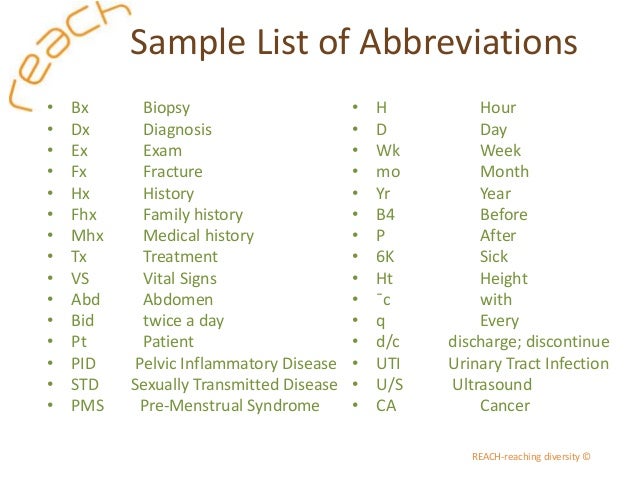
- Use abbreviations and symbols
- Use an outline to show :
- Main ideas
- Supports
- Examples
- Use our own language
Why do we have to review notes?
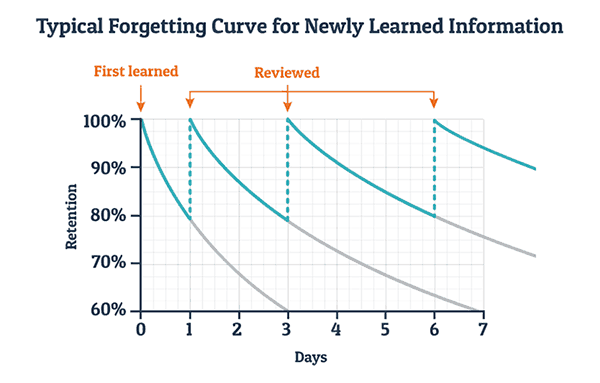
The forgetting curve is a visual representation of how we forget different pieces of information over time whenever we make no attempt to retain it. The more we try to retain a piece of information, the stronger the memory of that information becomes. The stronger the memory, the more likely that we will be able to remember the information over time.
What to do before class?
- Review the notes from the day before.
- Review your reading assignment.
- Make sure you have materials such as pen /pencils, paper / text or handout.
- Write the important date like examination date and dateline.
- Write the date to top of your paper for notes.
- Leave spaces between the lines so that you can add information later.
MODULE 12: NOTES TAKING EXERCISE USING CORNELL METHOD
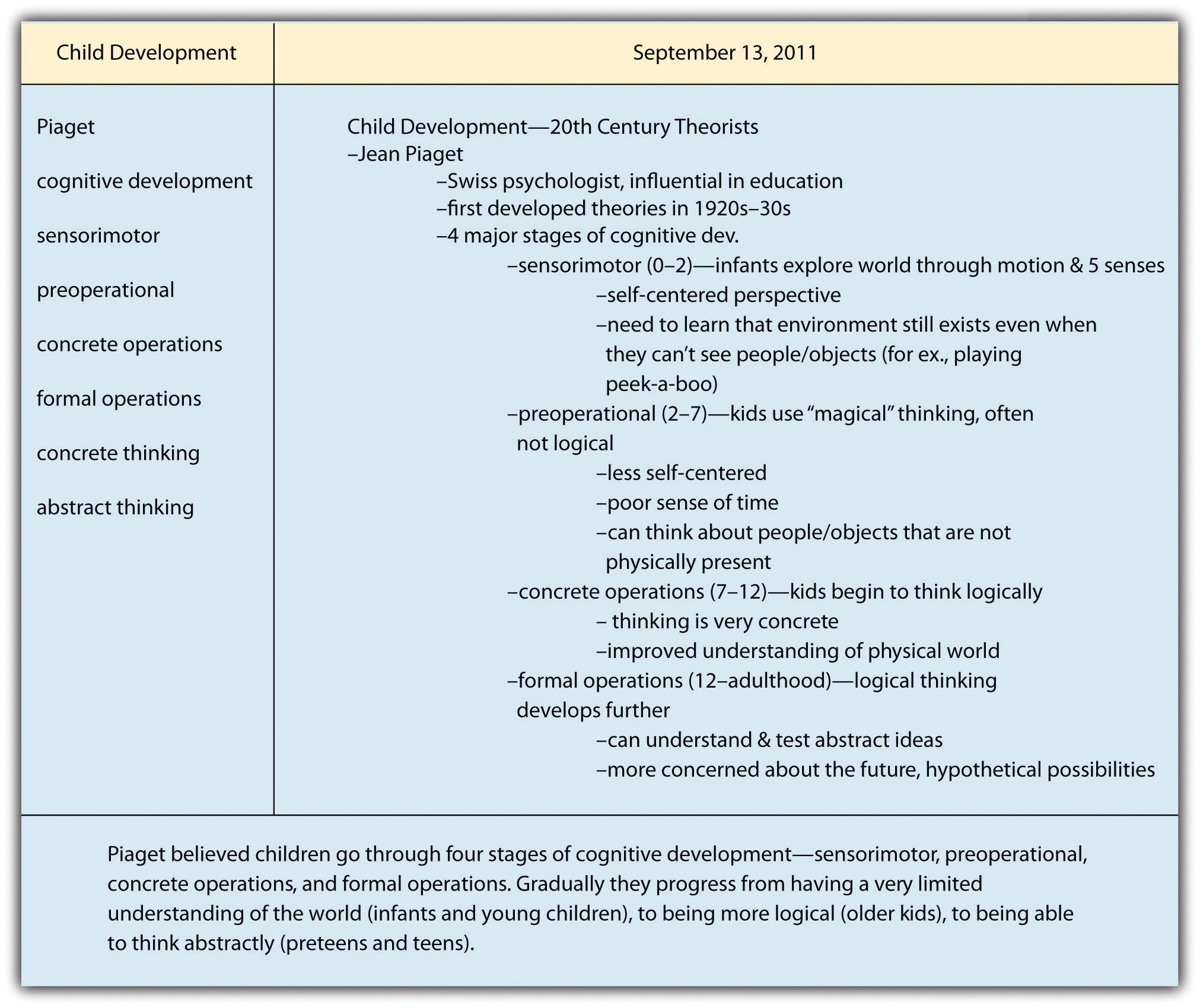
How to construct your own note using Cornell method:


Examples:

MODULE 13: GPA WORKSHEET
What is GPA?
GPA is a short form of Grade Point Average which represents a student’s academic achievement. A Grade Point Average (GPA) refers to the calculated average of the letter grades a student earns in each semester following a 0 to 4.0 scale.


- Example:

- Academic Status:

 UED12 STUDY SKILLS